from scipy.stats import spearmanr

# 예시 데이터 생성
np.random.seed(0)
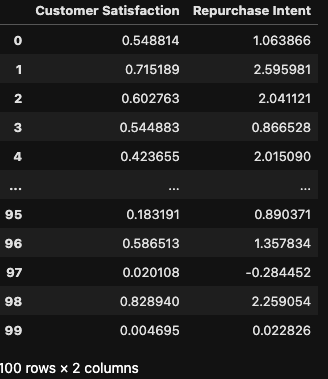
customer_satisfaction = np.random.rand(100)
repurchase_intent = 3 * customer_satisfaction + np.random.randn(100) * 0.5

# 데이터프레임 생성
df = pd.DataFrame({'Customer Satisfaction': customer_satisfaction, 'Repurchase Intent': repurchase_intent})
df
# 스피어만 상관계수 계산
spearman_corr, _ = spearmanr(df['Customer Satisfaction'], df['Repurchase Intent'])
print(f"스피어만 상관계수: {spearman_corr}")


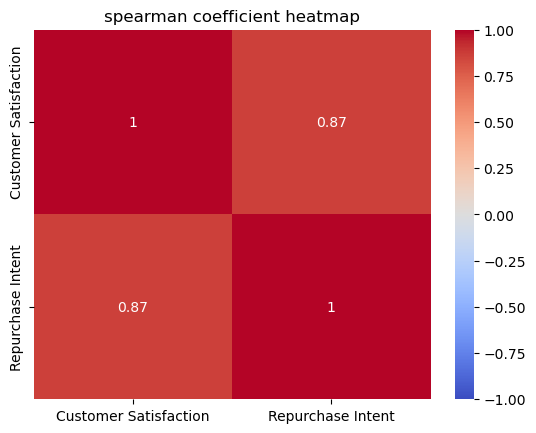
스피어만 상관계수: 0.8663546354635462
spearmanr: 두 연속형 변수 간의 스피어만 순위 상관계수(Spearman Correlation Coefficient)를 계산하는 함수입니다.
출력된 스피어만 상관계수는 약 0.87로, 이는 고객 만족도와 재구매 의도 간에 강한 양의 순위 기반 상관 관계가 있음을 의미합니다.
예를들어 사람의 키와 몸무게에 대해 상관계수를 알고자 할 때 키가 크고 몸무게도 더 나가면 일치 쌍에 해당, 키가 크지만 몸무게가 더 적으면 불일치 쌍에 해당 이들의 개수 비율로 상관계수를 결정
from scipy.stats import kendalltau

# 켄달의 타우 상관계수 계산
kendall_corr, _ = kendalltau(df['Customer Satisfaction'], df['Repurchase Intent'])
print(f"켄달의 타우 상관계수: {kendall_corr}")

켄달의 타우 상관계수: 0.6690909090909092
kendalltau: 두 연속형 변수 간의 켄달의 타우(Kendall's Tau)를 계산하는 함수입니다.
출력된 켄달의 타우 값은 약 0.67로, 이는 고객 만족도와 재구매 의도 간에 강한 순위 기반 관계가 있음을 나타냅니다.